Inhaltsverzeichnis
Gas-loaded Polymer
Components
Path: Main menu > Material > Create gas-loaded polymer…. Tab: Components
Path: Main menu > Material > Edit Material (file)…. Tab: Components
To define a gas-loaded polymer, select the polymer (Material A) and gas or choose the gas from the gas database. Further state the mass contents of polymer and gas and thermal conductivity, Sp. heat capacity and density of the gas if the chosen gas is not listed in the gas database.
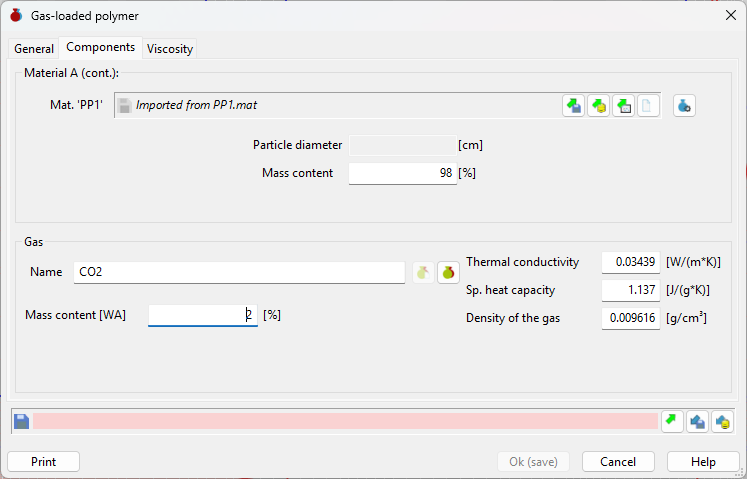
The calculation of all material data except of the viscosity is based on linear mixing rules.
Viscosity
Path: Main menu > Material > Create gas-loaded Polymer…. Tab: Viscosity
Path: Main menu > Material > Edit Material (file)…. Tab: Viscosity
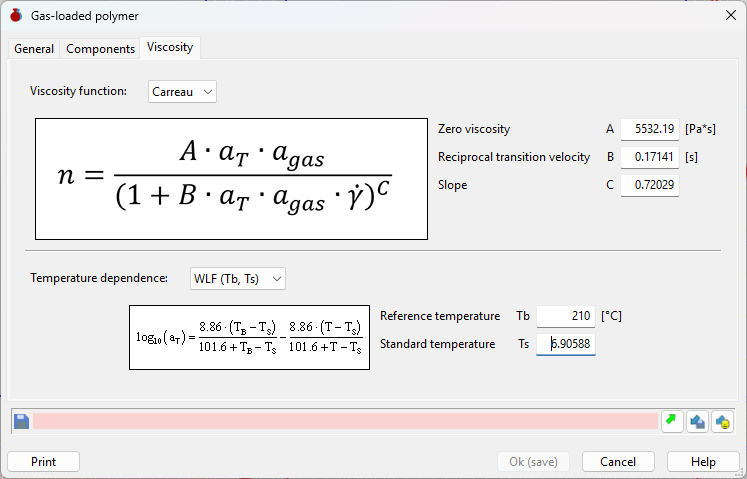
There is only one option to calculate the viscosity of a gas-loaded polymer in SIGMA. So, the Carreau function is preselected for the viscosity function.
Carreau:
$n = \frac{A \cdot a_T \cdot a_{gas}}{(1 + B \cdot a_T \cdot a_{gas} \cdot \dot{\gamma})^C}$
You can choose from different temperature dependence.
- WLF ($T_b, T_s$)
- WLF ($C_1, C_2$)
- Arrhenius
These different models for the temperature shift factor a_T are described in detail in subchapter rheological data.