Inhaltsverzeichnis
Strand Cooling
Strand Cooling
The Strand Cooling function is used for an approximate and/or model-based calculation of the temperature decrease of an extruded strand along a defined cooling section. A prerequisite for using this function is an existing and successfully calculated SIGMA process.
Further information on the model-theoretical background can be found here.
Prerequisites
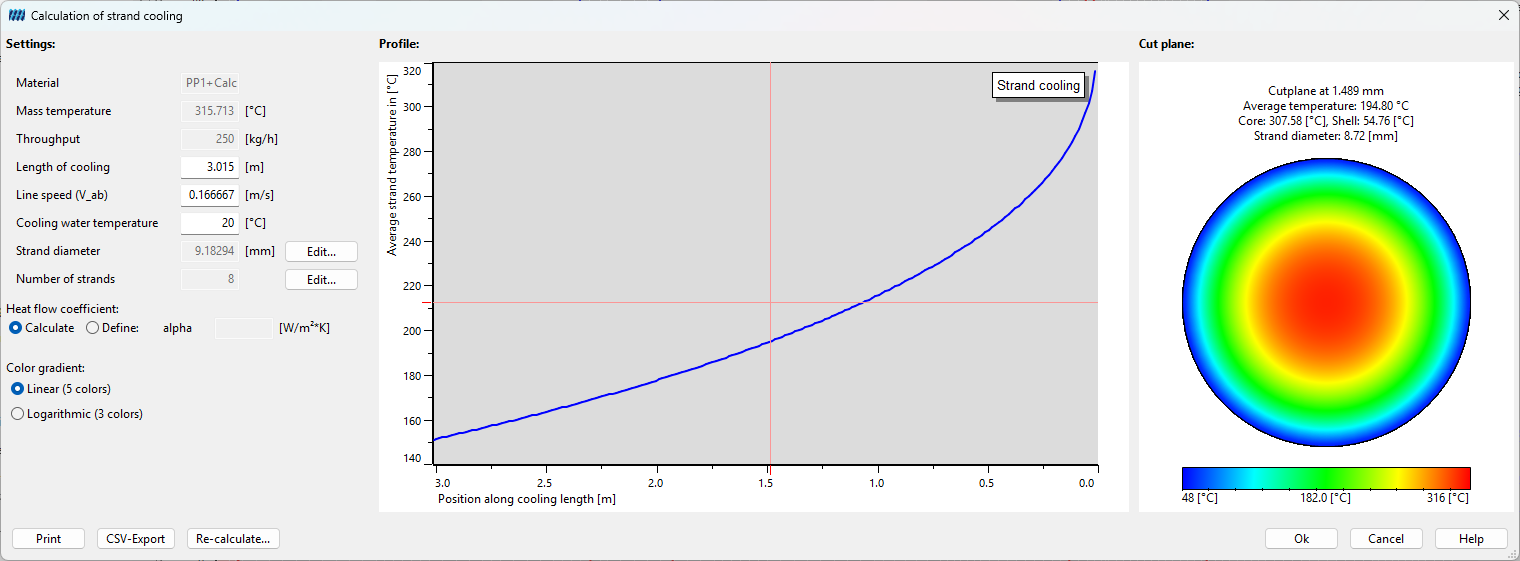
Before a strand cooling calculation can be performed, the following conditions must be met:
- A valid SIGMA process has been created.
- The process calculation has been completed.
- The material data used for the process is available in SIGMA.
The strand cooling function uses results from the previously calculated process simulation and applies them as initial conditions for the cooling calculation.
Automatic data transfer from the SIGMA process
When creating the cooling calculation, several relevant quantities are automatically transferred from the calculated SIGMA process:
- Material data of the material used in the process
- Mass temperature. This is taken from the calculated temperature at the screw tip or at the machine outlet.
- Throughput (at screw tip). The calculated throughput is used for the geometric assignment of the strand.
The automatically transferred outlet temperature defines the initial temperature of the strand at the beginning of the cooling section.
Relationship between throughput, strand diameter, and number of strands
Based on the calculated throughput at the machine outlet, one of the following quantities can be determined depending on the user selection:
- Strand diameter (for a specified number of strands), or
- Number of strands (for a specified strand diameter)
This allows the cooling calculation to be adapted to different plant and production scenarios.
Additional user input data
Further boundary conditions are required for the modeling and calculation of the cooling section. These values are not automatically transferred from the process and must therefore be entered by the user.
The following inputs are required:
- Length of cooling ** [m]: Total length of the section over which the strand is thermally cooled. * **Line speed [m/s]: Speed at which the strand is transported through the cooling section.
This parameter has a significant influence on the residence time of the strand in the cooling zone and therefore on the achievable cooling effect.
- Cooling water temperature [°C]: Temperature of the cooling medium (water bath) used for cooling the strand.
Calculation result
Based on the transferred process data and the entered cooling parameters, the strand cooling calculation determines the thermal profile of the strand along the cooling section. This makes it possible to estimate whether the desired outlet temperature after cooling will be reached.