Dies ist eine alte Version des Dokuments!
Mixing in Co-rotating Twin Screw Extruders
In order to obtain an overall description of the mixing effects within a co-rotating twin screw extruder one has to distinguish between three different mixing effects [Pot91], [For87], [Koc87], [Sch87], [Sch90], [Kes91], [PA90], [OC83], [Raa61], [Kre64], [Pah85], [BSL60], [Pot84], [PL85], [Lap85], [Pot88], [PA90]:
- Longitudinal mixing, due to the residence time distribution,
- Distributive mixing, due to the laminar shear flow within the extruder,
- Dispersive mixing, due to the shear stress distribution within the extruder.
These three effects are shown in the figure.
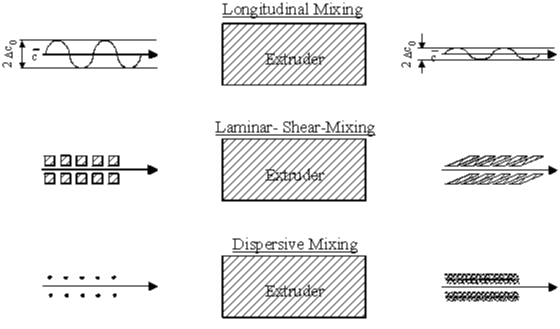
Figure: Mixing Effects
Evaluation of Mixing
One of the most important values needed in the evaluation of mixing capabilities is the residence time distribution. Approximation equations to calculate the residence time have been published by diverse authors. These models use the minimum and the average residence time to calculate the residence time distribution.
Longitudinal Mixing
To evaluate an extruder we need values, which are able to describe the mixing. The variance of the probability density function
$$\sigma^2 = \int_{\Theta_1}^{\infty} (\Theta - 1)^2 f(\Theta)d\Theta \tag{1}$$
can be used to describe the longitudinal mixing [Pot84], [PL85].
When the variance is greater, one can expect better longitudinal mixing. The solution of the integral gives a description of the variance $\sigma^2$ depending on the dimensionless minimum residence time $Q_1$. The figure compares the variance profile of a co-rotating twin screw extruder with that of another extruder.
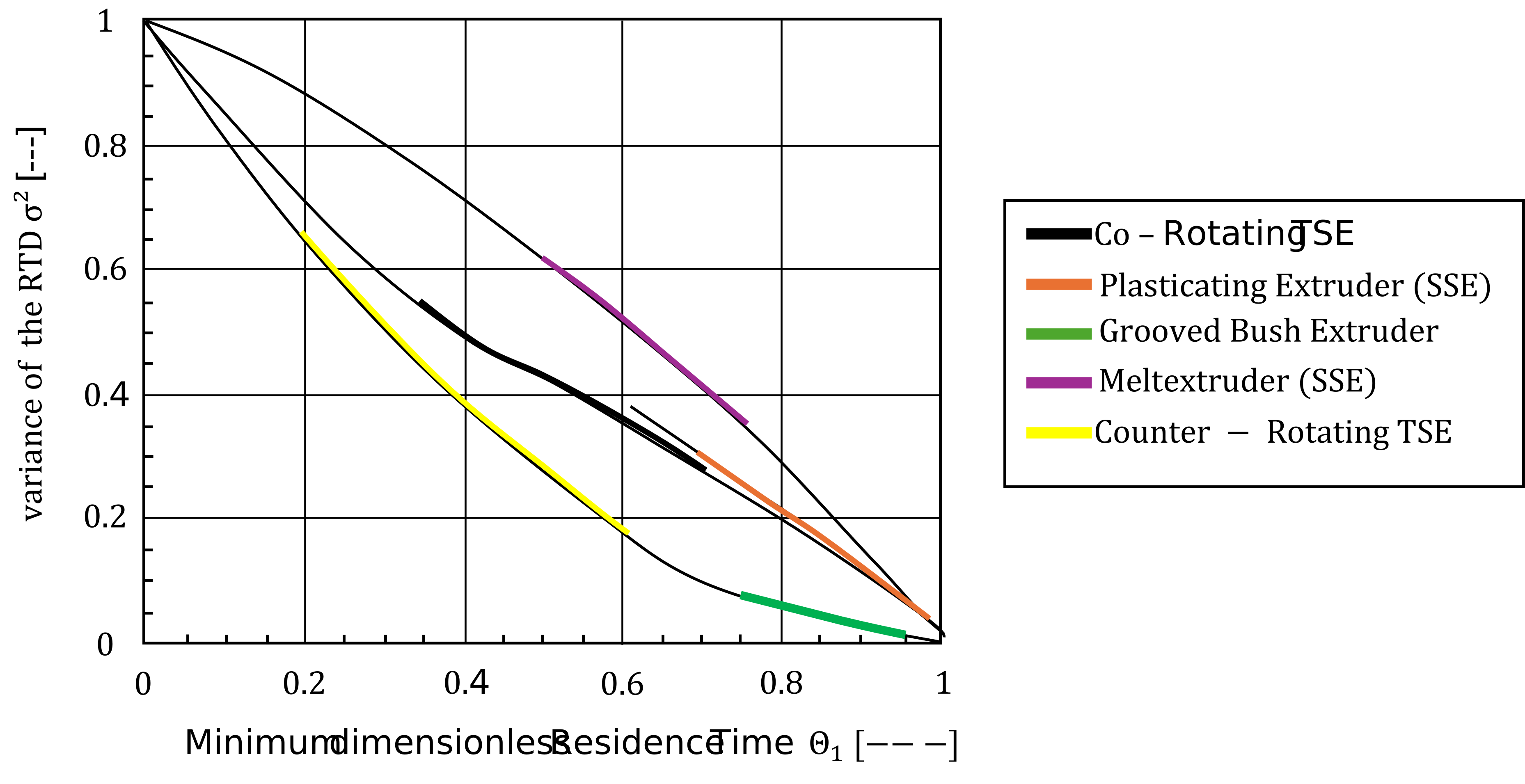
Figure: Variance vs. minimum dimensionless residence time
The bold lines represent the values usually found within those machines. Values that are not found within this area are deemed invalid. The minimum dimensionless residence time $Q_1$ takes into account the different geometries of the extruder. If $Q_1 = 1$ we find a bulk flow with a variance $\sigma^2 = 0$, in an ideal mixer we would find $Q_1 = 0$ with a variance $\sigma^2 = 1$ [Pot84], [PL85], [Lap85], [Pot88].
The variance profile of co-rotating twin screw extruders is almost identical to that of the smooth barrel single screw extruder. The values usually found for co-rotating twin screw extruders are shifted to lower values of the minimum dimensionless residence time. Because of this the variances can be achieved in co-rotating twin screw extruders.
Potente [PA90], [PA90] found a description of the variance which is valid for $0.35 < Q_1 < 0.75$:
$$\sigma^2 = 0.8 - 0.75 \Theta_1 \tag{2}$$
The maximum achievable value of the variance is approx. $\sigma^2 = 0.55$.
Axial Mixing Coefficient
Werner [Wer76] was the first person to introduce this value to characterise the mixing behavior of extruders. The axial mixing co-efficient is defined as the ratio of the leakage flow rate to the volume flow rate within one designated channel:
$$\sigma_M = \frac{\dot{V}_x}{\dot{V}_z} \tag{3}$$
The axial mixing coefficient can be used to characterise the width of a residence time distribution. The volumetric flow rates which are needed, can be calculated using the equations displayed earlier. The average axial mixing coefficient is calculated using eqn. 4.
$$\overline{\sigma_M} = \frac{\sum_i (\sigma_M L_{Ele})_i}{\sum_i (L_{Ele})_i} \tag{4}$$
References
[For87] Fornefeld, A.: Approximationsgleichungen zur Auslegung von Mehrzonen-Plastifiziereinheiten mit Scher- und Mischelementen, Dissertation, Universität Paderborn,, 1987
[Kes91] Kessler, H.: Modell zum stationären und instationären Mischen in konventionellen Einschneckenextrudern, Dissertation, Universität Paderborn, 1991
[Koc87] Koch, M.: Berechnung und Auslegung von Nutbuchsenextrudern, Dissertation, Universität Paderborn, 1987
[Kre64] Krekel, J.: Herstellung und Messung von Scherströmungen mit extrem großer Schubspannung und ihr Einfluss auf die Zerkleinerung von Agglomeraten, 1964
[Lap85] Lappe, H.: Untersuchung zum Verweilzeitverhalten von Schmelze- und konventionellen Plastifizierextrudern, 1985
[OC83] Ottino, J.M.; Chella, R.: Laminar Mixing of Polymeric Liquids; a brief rewiew and recent Theoretical Developments, Polymer Engineering and Science, 23(1983)7, 357-379
[Pah85] Pahl, M.H.: Mischen in Schneckenmaschinen, Teil 1 : Homogenisieren , Chem.-Ing.-Tech., 57(1985)5, 421-430
[Pah85] Pahl, M.H.: Mischen in Schneckenmaschinen, Teil 2: Suspendieren, Desagglomerieren und Emulgieren, Chem.-Ing.-Tech., 57(1985)6, 506-510
[PA90] Potente, H.; Ansahl, J.: Verweilzeitcharakteristik von dichtkämmenden Gleichdrall-Doppelschneckenextrudern, Kunststoffe, 80(1990)8, 926-932
[PA90] Potente, H.: Ansahl, J.; Optimierung von Schneckenpaaren für die Aufbereitung und Verarbeitung von vorwiegend Polyolefinen auf gleichsinnig drehenden Zweischneckenmaschinen, DFG Forschungsvorhaben Po 171/16-1, 1990.
[PA90] Potente, H.: Ansahl, J.: Residence Time Characteristics of Tightly Intermeshing Co-Rotating Twin Screw Extruders, Kunststoffe German Plastics, 80(1990)8, 29-32
[PL85] Potente, H.; Lappe, H.: Verweilzeit- und Längsmischgradgleichungen für Schmelzeextruder, Kunststoffe, 75(1985)11, 855-858
[Pot84] Potente, H.: An Analysis of Residence Time Distribution in Plasticating Extruders , Advances in Polymer Technology, 4(1984)2, 147-154
[Pot88] Potente, H.: Zum Mischen rheologisch inhomogener Stoffsysteme auf Einschneckenmaschinen, Rheologica Acta, 27(1988)4, 410-417
[Pot91] Potente, H.: Rechnergestützte Extruderauslegung., Kunststofftechnisches Seminar, Paderborn, 1991
[Raa61] Raasch, J.: Beanspruchung und Verhalten suspendierter Festsstoffteilchen in Scherströmungen hoher Zähigkeit,1961
[Sch87] Schultheis, S.M.: Approximationsgleichungen zur Auslegung von gegenläufigen Doppelschneckenextrudern, Dissertation, Universität Paderborn, 1987
[Sch90] Schulte, H.: Grundlagen zur verfahrenstechnischen Auslegung von Spritzgießplastifiziereinheiten, Dissertation, Universität Paderborn, 1990
[Wer76] Werner, H.: Das Betriebsverhalten der zweiwelligen Knetscheiben-Schneckenpresse vom Typ ZSK bei der Verarbeitung von hochviskosen Flüssigkeiten, Dissertation an der Universität München, 1976