Residence Time Distribution
Minimum Residence Time
The minimum residence time $t_1$ is defined as the period between the entrance and the first exit of the material at the screw tip. In a rectangular channel there is a section where no rotational flow occurs, regardless of the type of the flow. In the case of a Newtonian fluid the area is always located at $y/h = 2/3$. Particles moving on this particular streamline are exhibited to the minimum residence time. Based on this observation, the results presented by Bigg and Middleman [MB74] Lappe [PL86], [Lap85] proposed the following equation to calculate the minimum residence time:
$$\Theta_1 = \frac{3}{4}\pi_\dot V^{0.23(1-n)} \tag{1}$$
where $\Theta_1$ is the dimensionless minimum residence time, namely the ratio of the minimum residence time to the average residence time, $\pi_\dot V$ is the dimensionless throughput and $n$ the power law index. In the figure one can see the influence of the power law index on the minimum dimensionless residence time.
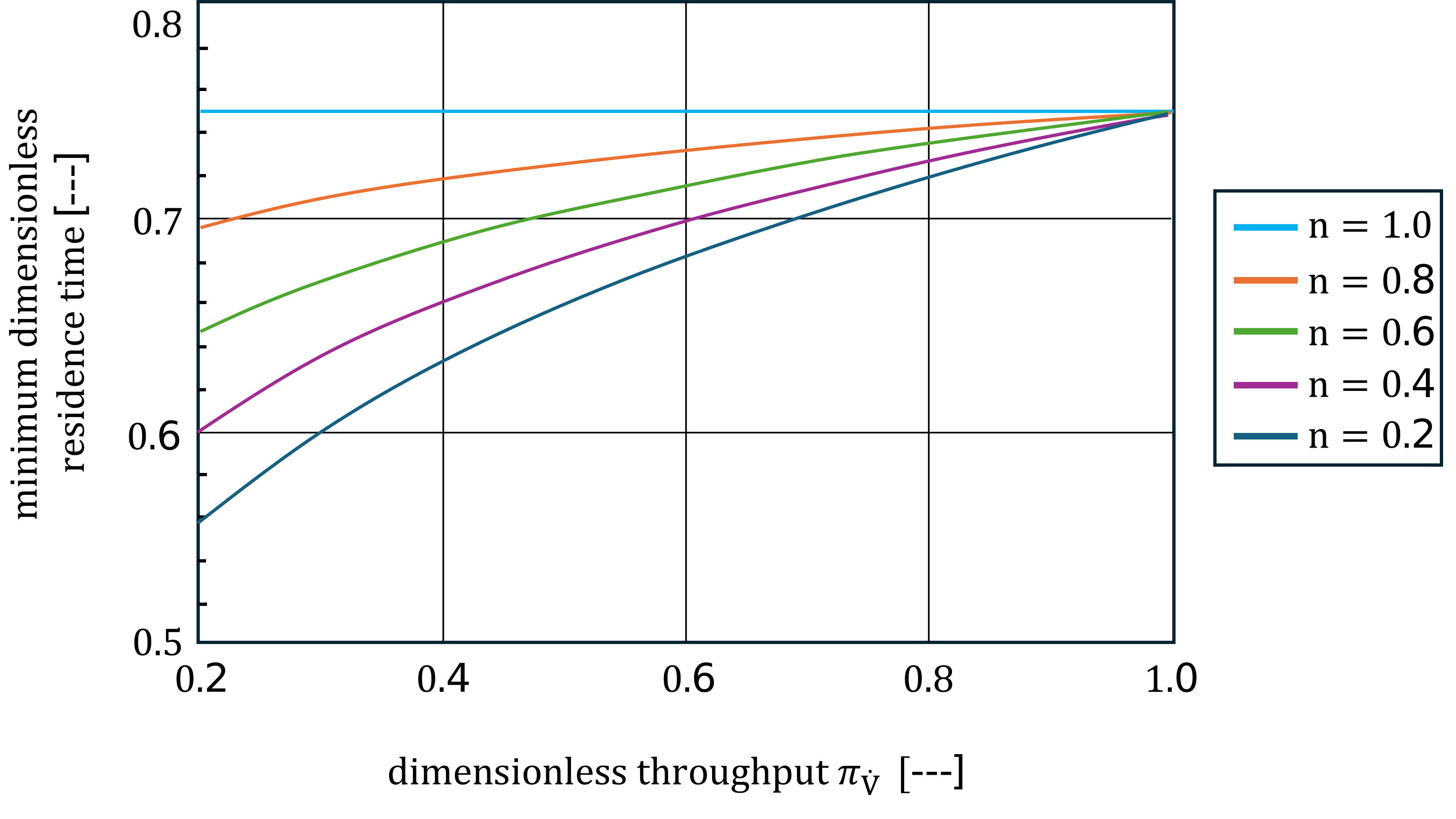
Figure: Influence of the Power Law index on the minimum dimensionless residence time [Lap85], [Pot84], [PL85]
$\Theta_1$ decreases for constant dimensionless throughputs $\pi_\dot V < 1$ with decreasing power law index n. One can see that the ratio of minimum and average residence time for a Newtonian fluid is always 0.75. This means that one cannot influence the dimensionless residence time by changing machine or processing parameters.
In order to calculate the minimum residence time one has to distinguish the following cases:
I. Conveying elements (right handed screw elements, conveying kneading blocks, etc.):
- 1. Solids Conveying Section
Case 1: f < 1 (partially filled)
$$\Theta_1 = \frac{1}{2} \tag{2}$$
Case 2: f = 1 (fully filled)
$$\Theta_1 = 1 \tag{3}$$
- 2. Melt Conveying Section
Case 1: f < 1
$$\Theta_1 = \frac{1}{2} \tag{4}$$ Case 2: f = 1
$$\Theta_1 = \frac{3}{4}\pi_\dot V^{0.23(1-n)} \tag{5}$$
II. Reconveying Elements (left handed screw elements, reconveying kneading blocks, etc. as well as neutral elements):
$$\Theta_1 = 1 \tag{6}$$
The overall minimum residence time is calculated by totalling the calculated minimum residence times in all sections of constant geometry.
$$t_1 = \sum_i (t_1) \tag{7}$$
Average Residence Time
The average residence time is defined as the ratio of the filled volume in one pair of screw elements to the volumetric flow rate:
$$\bar{t} = \frac{A_{fr}L_{Be}\bar{f}}{\dot{V}} \tag{8}$$
For a constant density follows:
$$\bar{t} = \frac{m}{\dot{m}} \tag{9}$$
The overall average residence time is calculated by totalling the calculated minimum residence times in all sections of constant geometry.
$$\bar{t} = \sum_i \left(\frac{A_{fr}L_{Be}\bar{f}}{\dot{V}}\right)_i \tag{10}$$
Analysis of the Residence Time Distribution
The residence time distribution of all screw machines can be described using a double Weibull distribution [PL86], [HKP89], [PFK+86], [Koc87], [Sch87], [Pot91], [Sch90], [Kes91], [PA90], [PA90], [PA90].
$$F(\Theta) = \left\{1 - e^{-c_1\left(\frac{\Theta-\Theta_1}{1-\Theta_1}\right)^{c_2}}\right\} \cdot \left\{1 - e^{-c_3\left(\frac{\Theta-\Theta_1}{1-\Theta_1}\right)^{c_4}}\right\} \tag{11}$$
This function depends on the minimum dimensionless residence time $\Theta_1$ and the parameter $c_1$ to $c_4$, which differ according to the type of machinery.
The double Weibull distribution for one machine depends on the dimensionless residence time: $\Theta = t / \bar{t}$ and the dimensionless minimum residence time. The differentiation of the double Weibull distribution $F(\Theta)$ results in the probability density function $f(\Theta)$. The integration of the probability density function $f(\Theta)$ within the limits $\Theta_1$ and $\Theta_2$ will result in the double Weibull distribution $F(\Theta)$,
$$F(\Theta) = \int_{\Theta_1}^{\Theta} f(\Theta) d\Theta \tag{12}$$
which is the sum of all tracer particles, which have left the screw machine. The values of this function are limited to values between 0 and 1.
The determination of the parameters $c_1$ to $c_4$ has to follow specific boundary conditions [PL85], [PFK+86], [Koc87], [Sch87], [Pot91], [Sch90], [Kes91], [PA90], [PA90].
- the values of the minimum dimensionless residence time $\Theta_1$ can only be within the range between 0 and 1.
- the average dimensionless residence time $\bar{\Theta}$ has the value 1.
- The distribution function must account for pure block flow with the boundary conditions
$$F(\Theta) = \begin{cases} 0, & \text{for: } \Theta < 1 \\ 1, & \text{for: } \Theta \geq 1 \end{cases}\tag{13}$$
,
- Furthermore, for pure block flow, the following applies: $\bar{\Theta} = \Theta_1 = 1$,
- the distribution function must describe the limiting case of the so-called ideal mixer with $\Theta_1 = 0$ via $c_1 = c_2 = 1$,
- the variance $\sigma^2$ of the probability density function
$$\sigma^2 = \int_{\Theta_1}^{\infty} (\Theta - 1)^2 f(\Theta)d\Theta\tag{14}$$
must decrease monotonically as a function of the shortest dimensionless residence time $\Theta_1$ and take the value 0 for $\Theta_1 = 1$ or the value 1 for $\Theta_1 = 0$,
- for physical reasons relating to the solid content, the variance $\sigma^2$ of the probability density function must always be smaller than that of a melt extruder. The melt extruder was discussed in [PL85].
References
[Eng87] Engelhardt, M., et al.: Unveröffentlichte Studien- und Diplomarbeiten an der Universität Paderborn, KTP 1987-1991
[HKP89] Hensen, F.; Knappe, W.; Potente, H.: Handbuch der Kunststoff-Extrusionstechnik, Band 1, Hanser Publishers, München, Wien, 1989
[Kes91] Kessler, H.: Modell zum stationären und instationären Mischen in konventionellen Einschneckenextrudern, Dissertation, Universität Paderborn, 1991
[Koc87] Koch, M.: Berechnung und Auslegung von Nutbuchsenextrudern, Dissertation Universität Paderborn, 1987
[Lap85] Lappe, H.: Untersuchung zum Verweilzeitverhalten von Schmelze- und konventionellen Plastifizierextrudern, 1985
[MB74] Middleman, S.: Bigg, D.: Mixing in a Screw Extruder. A Model for Residence Time Distribution, Industrial Engineering Chemical Found, 13(1974)1
[PA90] Potente, H.; Ansahl, J.: Optimierung von Schneckenpaaren für die Aufbereitung und Verarbeitung von vorwiegend Polyolefinen auf gleichsinnig drehenden Zweischneckenmaschinen, DFG Forschungsvorhaben Po 171/16-1, 1990
[PA90] Potente, H.; Ansahl, J.: Verweilzeitcharakteristik von dichtkämmenden Gleichdrall-Doppelschneckenextrudern, Kunststoffe, 80(1990)8, 926 - 932
[PA90] Potente, H.; Ansahl, J.: Residence Time Characteristics of Tightly Intermeshing Co-Rotating Twin Screw Extruders, Kunststoffe German Plastics, 80(1990)8, 29-32
[PFK+86] Potente, H.; Fornefeld, A.; Koch, M.; Schultheis, S.M.: Verfahrenstechnische Auslegung von Plastifizier- und Schmelzeaggregaten - Kunststofftechnisches Seminar, Universität Paderborn, 1986
[PL85] Potente, H.; Lappe, H.: Verweilzeit- und Längsmischgradgleichungen für Schmelzeextruder, Kunststoffe, 75(1985)11, 855-858
[PL86] Potente, H.: Lappe, H.: Analysis of the residence time distribution in conventioned plasticising extruders, Plastics and Rubber Processing and Application, 6(1986)2, 135-140
[Pot84] Potente, H.: An Analysis of Residence Time Distribution in Plasticating Extruders, Advances in Polymer Technology, 4(1984)2, 147-154
[Pot91] Potente, H.: Rechnergestützte Extruderauslegung, Kunststofftechnisches Seminar, Paderborn, 1991
[Sch87] Schultheis, S.M.: Approximationsgleichungen zur Auslegung von gegenläufigen Doppelschneckenextrudern, Dissertation Universität Paderborn, 1987
[Sch90] Schulte, H.: Grundlagen zur verfahrenstechnischen Auslegung von Spritzgießplastifiziereinheiten, Dissertation, Universität Paderborn, 1990