Polymer-polymer Mixture
Components
Path: Main menu > Material > New polymer (blend)… Tab: Components
Path: Main menu > Material > Edit material (file)… Tab: Components
To define a polymer-polymer mixture, select the two polymers that form the blend. Further state the mass contents of the polymers at the blend.
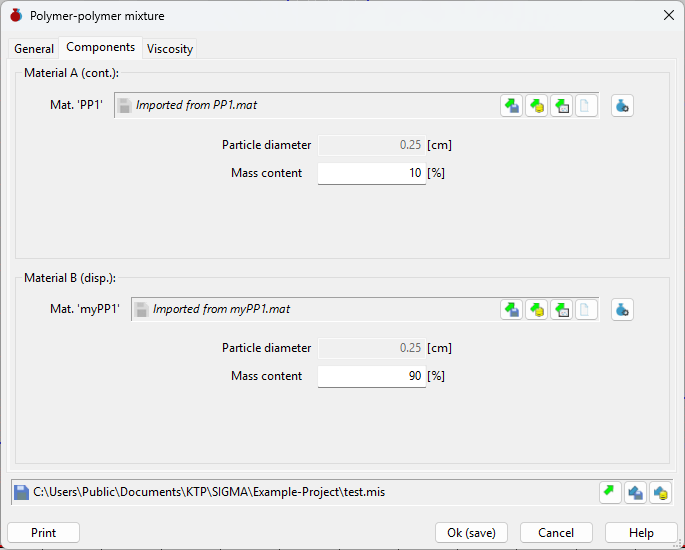
The calculation of all material data except of the viscosity is based on mixing rules. The mixing rules used are described in detail in the Reference Manual.
The relative materials have to be loaded. Furthermore the particle diameter and the mass content has to be determined in input field mass content [WA].
Viscosity
Path: Main menu > Material > New polymer (blend)… Tab: Viscosity
Path: Main menu > Material > Edit material (file)… Tab: Viscosity
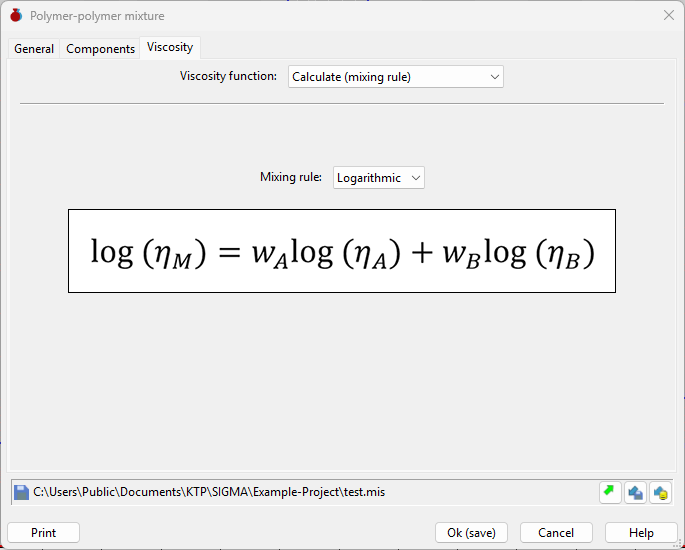
There are two options to calculate the viscosities of the blend. You can enter the rheological data analogous to the procedure for pure polymers. The other option is to let SIGMA calculate the viscosity of the mixtures using mixing rules. The following mixing rules are implemented in SIGMA:
- Logarithmic
$$\log(\eta_M) = w_A \cdot \log(\eta_A) + w_B \cdot \log(\eta_B)$$
- Maniford
$$\eta_M^{1/3.4} = w_A \cdot \eta_A^{1/3.4} + w_B \cdot \eta_B^{1/3.4}$$
- Grunberg
$$\log(\eta_M) = w_A \cdot \log(\eta_A) + w_B \cdot \log(\eta_B) + 2 \cdot w_A \cdot w_B \cdot G$$
- Taylor
$$\eta_M = \eta_A \cdot \left(1 + 2.5 \cdot \frac{\eta_B + 0.4 \cdot \eta_A}{\eta_B + \eta_A} \cdot \phi_2\right)$$
- Katoka
$$\eta_M = \eta_A \cdot \left(1 - \frac{\phi_2}{\phi_1}\right)^{-2}$$
- Takayanagi
$$\eta_M = \eta_A \cdot \frac{3 \cdot \eta_A + 2 \cdot \eta_B - 3 \cdot (\eta_A - \eta_B) \cdot \phi_2}{3 \cdot \eta_A + 2 \cdot \eta_B - 2 \cdot (\eta_A - \eta_B) \cdot \phi_2}$$